There have only been a few authors in my life that have left me almost not able to function until their next book comes out. That I read it as soon as I get my hands on it. In high school and part of college, that author was J.K. Rowling. Now, in my adult life, I have Karen Marie Moning.
It was actually my mom who discovered the Fever series seven or so years ago. I think back then there were already three or four books out, so I didn’t have long to wait until the next installment. (Now, the wait is longer, harder, but still totally worth it.) I was immediately sucked in to the seedy underbelly of Ms. Moning’s Dublin, where the Unseelie lurk and dark forces are at work to bring the walls between our world and the Fae’s down. I crushed on Jericho Barrons, a sexy, enigmatic antihero equal parts elegant and wild. And I loved the fever world’s kick ass heroine, MacKayla (Mac) Lane, who, over the series, transforms from a blonde, pink Southern girl without a care in the world to a fierce Unseelie fighter and a protector of Dublin, the city she’s grown to love even though it took her twin sister, Alina.
The first five Fever books are primarily from Mac’s point-of-view. Fans of the series know that the last book, Iced, was Dani “Mega” O’Malley’s time to shine, with some insight into Christian MacKeltar’s life as he made the agonizing transformation from sexy, Highlander druid to insatiable Unseelie Prince, as well as Kat’s POV and life with the sidhe-seers at the abbey. I feel like not too many people were thrilled with a book that was told mostly from Dani’s POV, and, although perhaps not my favorite in the series–I think that honor still goes to Shadowfever–I enjoyed Iced, and Dani’s story was definitely one that needed to be told.
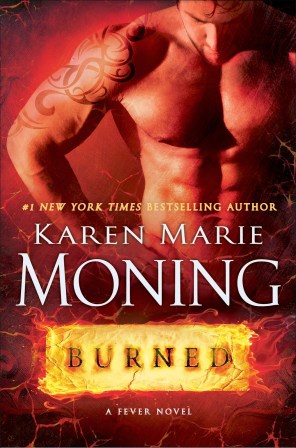
In Burned, “Mac is back,” as it quotes on the front cover–and I think Ms. Moning’s got her groove back. The book was fun, sexy, packed with action and suspense, and I couldn’t put it down. Well, somehow I managed to for a few hours to get some shut-eye, but this morning I was right back reading, and I finished it within the day. Like I said, not many books have sucked me in quite like the Fever and Highlander series have. I devoured it, and when it was over I was in some sort of book haze/coma, wanting more but knowing that more probably won’t come for another year, maybe longer.
Ugh.
I’m not sure what to even say about this book–like Shadowfever, there are so many twists in it–and so many inklings of things to come–I’m not sure I can talk about it without accidentally giving something away. I can say, though, that it centers mostly around Mac and Dani’s relationship, which–if you’ve read the series–you know was tried when Mac found out Dani, of all people, was the one who killed her dear twin sister, Alina. (You find out even more about the circumstances surrounding this in Burned.) Mac and Jericho’s relationship, which was sort of wrapped up nicely enough at the end of Shadowfever (I will always remember the quote, “I will always be priya for this man.”), is also tested in this latest installment.
Although most of the story is told from Mac’s POV, we get glimpses of Barrons at the very beginning, the Unseelie king, Christian as he’s being tortured by the Crimson Hag, Kat as she struggles to maintain leadership of the sidhe-seers at the abbey, and even Lor. (I have to admit, out of all the POVs, I think I enjoyed Lor’s the least, although I guess he was kind of amusing. I just didn’t find it very convincing–it was a little too much for me, although he and his budding love interest were sort of cute towards the end.) We also get glimpses of a new, ultra kick ass assassin, Jada–who, even though her dialogue is reminiscent of Seven of Nine’s in Star Trek: Voyager (everything is inefficient), she turns out to be oh so important. The transitions between the first (and third) person POVs works well for the book and, even though Ms. Moning conveniently labels each chapter with the character’s name, the styles are different enough that I think you’d be able to tell them apart, anyway–something I hope I can master.
There are also some very old friends in this book–namely, twins Drustan and Dageus MacKeltar from the Highlander series. They’re pivotal to the mission to save Christian from the clutches of the Crimson Hag. New troubles are also brewing in post-apocalyptic Dublin–problems even the Unseelie king may not be able to fix (and it’s questionable whether he even wants to). Although some issues leftover from Iced are resolved, and Mac comes to term with some demons from her past, there are still lots of loose ends at the end of Burned and a slight cliffhanger, which will leave you yearning for the next book.
This book got me right in the feels, and I know I won’t be able to shake it all week. I even called my mom to fangirl about it…which, in retrospect, was kind of mean because she won’t read it until I bring my copy home with me, lol. If you’re a fellow Moning Maniac, I know you will love Burned. If you haven’t read the Fever series–do it. Immediately. And the Highlander series, too–or at least the Immortal Highlander.
Only two more weeks until Relapse comes out…..eek!!!!! Why did I decide to release it right after Thanksgiving again? Oh, right, because I love you guys, and I want you to have something to read over winter break. 😉
Before we go on with today’s post, I thought I’d mention I got a little (very, very little) writing done this weekend…335 words, to be exact. I’m working on a novella from Anna’s POV. The novella takes place somewhat parallel to the events in Reborn. I don’t know if I’ll do anything with it, or if it will become part of the next book. I’m mainly doing it to find her voice and flesh out her back story, since I want to incorporate more from her POV in future books.
But, anyway, that’s not what today’s post is about. I want to talk about influences: the authors, themes, and types of characters I’ve become obsessed with over the years. This may turn into a two-part post…we shall see…
1. Mischief and Mayhem
As a reader and writer, I’ve always been intrigued by the idea that there could be these otherworldly, always mischievous (and often malevolent) beings sort of lurking in the background, in worlds adjacent to our own, influencing it in ways we don’t realize. (Or sometimes, as they do in Reborn, they get very mixed up in our world.) It’s a totally freaky, even creepy idea–one I think is so much fun to explore in fiction, but nothing I actually believe in real life. When I was first playing around with the story that would eventually become Reborn, this is the concept I knew I wanted to capture. I wanted my supernatural beings to be volatile, mischievous, and manipulative–characteristics often embodied by The Fair Folk. I’m talking about the devious Fair Folk of Irish lore, or like Puck et al in A Midsummer Night’s Dream, not the Disney fairies like Tinker Bell, lol. To be quite honest, I don’t know a lot about Irish folklore besides what I’ve seen other authors use–and they’ve incorporated it quite well already into works of fiction, so I wanted to do something a little different.
I think Karen Marie Moning’s Fae are the best–but, as she is my favorite author, I’m probably biased. In Moning’s Highlander and Fever series, the Fae are arrogant, devious, and lethally seductive. Back in the day, I wrote a book review of The Immortal Highlander–my absolute favorite of her Highlander romance novels. Immortal’s antihero, Adam Black, is a good example of this type of character, although he’s not mischievous in a cruel way. The Seelie Queen places a curse on Adam that strips him of his immortality and makes him invisible. His is a hopeless case until he meets Gabby, a sidhe-seer–gifted with seeing beyond the glamour used by the Fae, and the only one who can see Adam. Since Gabby seems to be his only hope, Adam ingratiates himself into Gabby’s life and eventually convinces her to help him. It’s been awhile since I’ve read this book, but I remember Adam perched on Gabby’s desk at her law firm while she tried to get work done, nagging her. Obviously, that kind of behavior would be super creepy and annoying in real life, but the love-hate dynamic between Adam and Gabby made for a very entertaining book. It didn’t help that Adam’s glamour was that of a sexy Scottish Highlander, making it almost impossible for Gabby to resist him.
Moning went on to write the Fever series–a sexy urban fantasy series in which the walls between our world and that of the Fae become even thinner. The Immortal Highlander isn’t an official prequel to the Fever series, but it’s definitely where her books about time-traveling, sexy Scottish Highlanders start to get much darker, and it sets up the conflict for her later books. I think the Fever series was a pretty daring one–primarily, I’d call it an urban fantasy, but Moning combines elements of a bunch of different genres and just makes it work so well (mystery, sci-fi, romance, and they’re funny as hell). I’d say for marketing purposes, it’s a good strategy to choose one or maybe two genres that your work fits into, but her books have taught me that it’s okay to push the limits of a genre and mix things up a bit.
A very much related type of character is:
2. The Trickster
You didn’t really think you’d get through this post without a picture of Hiddles, did you?
The Trickster is, according to TV Tropes, which I can’t stop reading lately, a type of character that “plays tricks or otherwise disobeys normal rules and conventional behavior.” This is definitely related to what I’ve described above, but I’m separating them out. We can depict these qualities in an entire race, like the Fair Folk (or the Olympians…), or in an individual character (whose peers may or may not embody these traits). I prefer the darker, more anti-hero-ish tricksters who use outright manipulation and deception to get what they want, without (much) remorse. They also pretty much pop in and out of places and situations as they like without a whole lot of consideration for rules or puny humans other people. Recent examples include Rumpelstiltskin on ABC’s Once Upon A Time and Loki in the Thor franchise. Another classic example (teehee) is Jareth from Labyrinth.
One of my other favorite trickster types is Julian from L.J. Smith’s The Forbidden Game. I’ve most definitely fan-girled over this trilogy before on this blog, but it’s one of my all-time favs. One of my friends introduced me to L.J. Smith back in freshman year or so of high school, and my life was changed, forever. (Dramatic much?) These books were already ten years old or so when I originally read them, and now…yes, I just confirmed on Wikipedia, The Forbidden Game is twenty years old. Aaaaaand now I officially feel old.
Anyway, I reread them this summer (they were first published as separate books, but since they’re short, they’re published now in an omnibus edition), and…they were still good. Sure, they’re written at about a middle school reading level, and, since they are so short, I noticed some of the repetition. Smith is a fan of the epithet, which, in a longer book, may help you remember each character–but, in a shorter book, it gets repetitive. Even so, there’s just something about Smith’s writing I’ve always loved. It almost has a beat to it–like poetry.
The Forbidden Game is an urban fantasy trilogy with a tiny blonde-haired, green-eyed protagonist named Jenny Thornton. Jenny starts out as an innocent, naive girl still dependent on her childhood sweetheart, Tom. (I mean, Tom’s nickname for her is Thorny. You don’t get any more disgustingly cute than that.) There’s mystery and magic from the start of Book One, The Hunter, when Jenny, who is being followed by two delinquent-types, takes refuge in a strange store called “More Games.” She buys a game in a plain white box, simply called “The Game,” from the even stranger boy running the shop. Of course, with his white-blonde hair and otherworldly blue eyes, he’s über attractive–and, despite his seeming indifference towards her, Jenny feels a strange connection to him.
That night, Jenny, Tom, and the rest of their friends start to play The Game, setting up a paper house and drawing their worst nightmares on sheets of paper. The next thing they know, they’re inside the paper mansion, transported there by the cyberpunk boy from the More Games store. His name is Julian, and he’s the youngest of an ancient race called The Shadow Men. In order to win Julian’s twisted game, Jenny and her friends must confront their worst fears–and, if they lose The Game, they lose their lives. Julian is a predator and master of manipulation (and very Jareth-esque). Of course, as the series goes on, you find out that Julian maybe isn’t the ultimate big bad he claims to be.
The Forbidden Game includes one of L.J. Smith’s favorite themes (and, okay, one of mine): the love triangle. Ms. Smith’s love triangle is usually set up as the relatively innocent girl caught between the good guy/hero type and the seemingly bad boy/antihero. In this case, Jenny’s good guy is Tom, and Jenny’s bad boy is Julian. Jenny knows that sweet and caring Tom is the guy for her, but she can’t help but be tempted by Julian’s beauty and charisma. These books are also about obsessive love: Julian is obsessed with Jenny and will do anything to have her.
Which brings us to one of my other favorite topics, and the final one for tonight:
3. Forbidden Desires
Two of my favorite themes in fiction are sin and temptation (well, what is perceived to be sinful by that character). Often, this takes the form of fairly-innocent-girl-gets-tempted-by-dark-sexy-mysterious-man’s-dark-world-of-…..darkness…..okay, I’m becoming less and less articulate as this post goes on, but you get the gist. 😉 Let’s just call it forbidden love/lust. This theme probably at least in part stems from the idea of sex as a sinful or evil act–perhaps a very Western/Christian notion. In some of these stories, the innocent heroine, initially intrigued by the sexy, devilish antihero, ultimately resists temptation and does the “right” thing. Going further with this interpretation, maybe it has something to do with the antiquated notion that women retain their virtue and innocence for as long as possible. And, even though I don’t agree with that, it’s a fun theme to explore in fiction. This is probably why Nathaniel Hawthorne, who was big on writing about sin, temptation, and the hypocrisy of the Puritans, remains one of my favorite classical authors.
Like I said, The Forbidden Game is the perfect example of this. Throughout the series, Jenny has to battle against her attraction to Julian in order to do the right thing and save her friends. But Julian’s influence on her isn’t all bad: Jenny transforms from the innocent girl who still relies on her boyfriend for everything into a more independent and confident young woman who thinks for herself. This theme of the allure of darkness is also a major theme in the musical The Phantom of the Opera. And in a certain 80s children’s fantasy movie.
With the relatively recent explosion in popularly of paranormal romance and other darker forms of romance and fantasy, the above types of characters and themes are fairly common right now–although not every author approaches them in quite the same way. These otherworldly characters, whether they’re the Fae, gods, fallen angels, vampires, etc., may be charming and alluring, but they’re also cunning, dangerous, predatory, and don’t play by our (human) rules. Of late, they’re also typically inhumanly beautiful, which further emphasizes their almost irresistible pull and maybe plays a little bit into the notion that not everything attractive is good for you.
*****
When I think of what a paranormal romance is–just what exactly the genre encompasses–these types of characters and themes are what come to my mind. I think everybody is a little bit different with regards to this. Although many paranormal romances still have that major, initial element of forbidden love, some authors go on to develop a story that is a little more traditionally romantic/lovey dovey, and it’s this type of story a lot of readers are used to now. Since I’ve been marketing Reborn as a paranormal romance, I think a few people have been confused by how I chose to approach Siobhan and Jasper’s relationship. It’s not traditionally romantic–it’s passionate and intense, but also a roller-coaster ride, and even a bit scary at times. That’s because the, er, “classic” paranormal romances, like L.J. Smith’s work, combine themes from the romance and horror genres. I’m not even sure “romance” is the right word, except that it captures the passionate relationship between the two lead characters. But these stories are also about temptation, forbidden desires, obsessive “love,” good and evil, dominance and submission, predator and prey. The settings are dark, mysterious, and sinister–as are some of the characters.
If you’ve read Reborn, you may see now how the above ideas have influenced it. My Olympians are, for the most part, volatile, capricious, mischievous, and manipulative. And even the ones that aren’t completely devious have a dark side (as the tagline for Relapse says, everybody has one…although perhaps not quite to the extent that my characters do, lol). Siobhan isn’t completely innocent in the conventional sense, but she’s a bit of a small-town girl thrown, thanks to Jasper, into the darker, alluring world of the Olympians. Jasper is her forbidden fruit–Siobhan knows he’s dangerous, but is tempted all the same (and Jasper will go to any lengths to keep her). And, unlike the strong, “virtuous” ladies described above, Siobhan isn’t as good at resisting temptation. In Relapse, Siobhan’s struggle against this forbidden world is taken to a new level as she begins to realize she’s more like the manipulative, control-freak Olympians than she thought. As a final tease, you’ll also meet a new character in Relapse–a sexy, silly, trickster-type like Jareth or Julian. I’m excited for you to meet him. 😉
Clockwork Angel is the first book in Cassandra Clare’s The Infernal Devices trilogy. I love Ms. Clare’s The Mortal Instruments series (City of Heavenly Fire is sitting on my bookcase, waiting patiently for me to read it…but it looks sort of daunting…), and it took me awhile to get around to starting The Infernal Devices…but I am oh so glad I did. For me, it was a five-star read. In my opinion, the back cover book summary does not do this book justice. It makes it sound like it’s only about a love triangle–which, for better or for worse, there is a love triangle in this book. That device has sort of exploded along with YA lit in recent years. But anyway, there is so much more going on in this book than that, and I fell in love with all of the characters.
Our heroine, Teresa (Tessa) Gray, comes over to London from the States when she gets a note from her brother, Nathaniel, who moved there for work. Unfortunately, in London she falls into the clutches of the Dark Sisters. They force her to practice her unique ability–with the touch of a personal item, Tessa can shape shift into the person it belongs to–a power she didn’t even know she had until now. If she doesn’t do as the Dark Sisters say, they threaten to hurt Nate. Things are looking pretty grim when they inform Tessa that she is ready to marry the mysterious, powerful Magister. Thankfully, a group of Shadowhunters break into the Dark House and rescue Tessa on what would probably have been her wedding day.
Tessa becomes a guest at the London Institute, run by Charlotte and Henry Branwell and home to three orphans: Jessamine Lovelace, James (Jem) Carstairs, and Will Herondale. She learns about the Nephilim, the world of the Shadowhunters, and the Downworld of vampires, werewolves, faeries and warlocks–the world she herself is a part of. Much of the book is Tessa learning to accept this knowledge, and to accept herself and her ability. There’s also a lot of great action, suspense, and yes, romantic tension, as well as an unexpected twist toward the end.
I loved all of the characters in this book. Cassandra Clare does a magnificent job of weaving together the world of the Shadowhunters with Victorian England. Charlotte, who is truly in charge at the Institute, struggles to make her voice and opinion heard at the Enclave meetings mostly dominated by men. Henry, on the other hand, is too busy tinkering with inventions to run much of anything. I loved Henry–he was the eccentric scientist/inventor whose inventions never quite worked the way they were supposed to. These two worlds also conflict in the character of Jessamine. She’s an aspiring proper Victorian lady who claims to reject her calling as a Shadowhunter, but she’s kind of a bad ass when duty calls. Her parasol turns into a weapon (that was a nice touch).
And then there’s Will and Jem–parabatai, like Jace and Alec are in TMI. There’s a bit of mystery surrounding each of them; both seem to harbor dark secrets, especially Will. Tessa finds herself drawn to each of them, of course. Jem is kind and brave, but unfortunately suffers from a mystery illness that makes it difficult for him to fight. And Will…..well, Will is the gorgeous, dark-haired, arrogant, sarcastic, broody one who lashes out at people because he’s compensating for his inner turmoil/vulnerability–so, naturally, he’s my favorite. Sorry not sorry. You get to find out Jem’s secret in Clockwork Angel, but Will’s past and why he’s so broody and angry is still shrouded in mystery at the end of the book, which was REALLY frustrating, and made me want to read the next two immediately, except I don’t have them yet. I mean…Will’s not the only reason I want to keep reading, but I won’t pretend like he’s not one of the reasons. Oh, Cassandra Clare, why must you do this to me?
Clockwork Angel also had an awesome ending. Besides the twist, Tessa learns to at least partly accept her unique ability and uses it in a really incredible way. I much prefer when the main character outwits his or her opponent rather than killing them or something. I mean, if the villain was dead after the first book, it probably wouldn’t have been a trilogy, but I just think it makes for a more creative resolution. Tessa is a strong female lead, and I’m excited to see how she grows in the series.
Last but not least, I’m so glad Magnus Bane is immortal, so that he can be in ALL of Cassandra Clare’s books. He was only around a little bit in this book, but the ending hints that he might have a bigger presence in Clockwork Prince. I hope. He better.
I haven’t done a book review on here for a while, and I have quite a few to get caught up on. I read the first two books in Becca Fitzpatrick’s Hush, Hush series back in May, and finally got around to reading the third and fourth book this August. I decided to just review all of them briefly in one post. Overall, I really enjoyed them, although unfortunately the last installment didn’t quite pull me in like the others did.
I actually became curious about the series because of a few bad reviews I saw about it. Well, “bad” is probably putting it lightly…”scathing” is more like it. And they had less to do with Ms. Fitzpatrick’s writing style/plot/characters and more to do with her main male character, Patch, her quintessential reformed (or is he?) bad boy character, because, you know, it’s impossible to enjoy a character in a book/TV show/movie while recognizing their less desirable qualities wouldn’t make for a good partner in real life. (That’s sarcasm, by the way.) And, although they’re in the minority, she’s also gotten some bad reviews on Goodreads…and this time, by “bad,” I mean actually just pretty horrible and inappropriate. Basically just bullying. I mean, it’s the Internet, so they could be trolls…but if they’re not, there’s really no good excuse for bullying anyone, ever, no matter how justified you think your cause is. (I know by now you’re probably wondering what the heck I’m talking about, so go on Goodreads and take a look for yourself.)
A little more about this at the end of the post. For now, let’s take a quick look at each of the books:
1. Hush, Hush
I thought this was a great debut novel, and I thoroughly enjoyed Ms. Fitzpatrick’s writing style. She sets the story in the slightly dreary Coldwater, Maine, and creates this perfectly sinister, creepy, Halloween-ish atmosphere. It was reminiscent of L.J. Smith’s earlier work (although, in my mind, few people–if anyone–can trump L.J.). Yes, at this point the plot-line is somewhat overdone and predictable, but I gobbled it up just the same: Nora Grey, a smart, cute-if-something-of-a-misfit high school student, encounters Patch, dark, mysterious boy who seems like bad news, and yet Nora can’t resist his magnetic pull (obviously). I know I sound snarky, but I honestly devoured it. The book is mostly centered around unraveling the mystery that is Patch and his relationship with Nora.
Some have criticized the book as being a Twilight ripoff. There are some parallels, but nothing that jumped out at me as obvious plagiarism. I mean, to give credit where credit’s due, Twilight did open up the market for teen paranormal romance, so there are going to be some similarities. But it is also quite possible for two or more people to come up with fairly similar ideas without being influenced directly by each other’s work.
The books are told from Nora’s point-of-view, and I really liked her character. She’s a smart, motivated high school student. Her best friend, Vee, adds some comic relief to the series and is my favorite character. Nora is also the victim of some pretty vicious pranks by Coldwater’s resident mean rich girl, Marcie Millar. I enjoyed most of the characters, even though secondary ones like Vee and Marcie never seem to break out of their stereotypes. (Marcie starts to, a little, later in the series.)
In fact, I have to say the only character I found to be a little underwhelming was…Patch. For being the dark, mysterious, sexy bad boy, he didn’t really pop off the page for me as much as he should. Also, I never could quite get past his nickname. Patch is just not a sexy nickname, in my opinion. It makes me think of an old pirate with missing teeth or a little kid who gets into a lot of mischief and ends up hurting himself.
But, overall, an entertaining read. I gave it four/five stars on Goodreads because it built up a lot to a twist at the end that wasn’t that earth-shattering. (There is, however, a perfectly creepy seen at Delphic amusement park and a particular ride called the Archangel…I LOVE creepy amusement parks in horror/paranormal books!!!)
If you haven’t read Hush, Hush yet and plan to, I’d stop reading now…spoilers ahead…
2. Crescendo
In Crescendo, we delve a little further into Ms. Fitzpatrick’s dark world of sexy fallen angels and the cursed Nephilim–the children of fallen angels and humans, languishing in between these two worlds and destined to swear fealty to fallen angels. We know that Patch was a fallen angel in Hush, Hush, but, due to the events at the end, now has his wings back and is a guardian angel. But his relationship with Nora isn’t picture perfect, and she catches him doing some pretty suspicious things…like hanging around her arch-nemesis Marcie an awful lot. It doesn’t help that Vee is dating Rixon, Patch’s bff, so Nora can’t quite avoid Patch/people-that-know-Patch completely. Meanwhile, her mother forces her to reconnect with a childhood friend, Scott, who turns out to have some dark secrets of his own. Rixon, though, was my favorite character in this book until…..oh, Rixon…..
From what I recall, this book ended with a cliffhanger, so be prepared for that.
Four/Five Stars
3. Silence
I enjoyed Silence a lot more than I expected I would considering what happens in the first few pages. Which, thankfully, I can tell you about, since it’s in the book’s synopsis and not a spoiler! Nora can’t remember the past five months of her life…including, of course, Patch. So, yes, part of the book ends up being a series of revelations that the reader already knows. This could have ended up super annoying, but I think Fitzpatrick did an excellent job with it…at least for me, I could see where it might bug some readers. I also enjoyed Patch’s character a lot more in this book, and there were some pretty sexy scenes.
I also gave this book four/five stars, and I did have a few issues with it. First off, what happens to Vee in this book, and especially in the last book? Isn’t she Nora’s bff? Where did she go? It’s like she just disappears for large chunks of books three and four. Since I liked her so much, this was really upsetting. Also, Fitzpatrick seems like she’s setting up a whole Scott-Nora-Patch love triangle…not that I necessarily wanted that to happen, because that’s overdone, too, but it definitely seemed headed in that direction, and then it just…doesn’t. (And then you find out in book four that Scott thinks of Nora like a sister? Um, his affection for her in Silence definitely does not seem brotherly.) There’s also a lot of to-do about Nora and Scott going “as friends” to her homecoming dance–Marcie drags Nora out shopping for a dress, and they make a really big deal about finding a dress, and then–the dance doesn’t happen. The book ends before the dance happens. I found this to just be really strange and kind of sloppy. But I’m still giving it four stars for having a nice blend of sinister, romantic, steamy and funny moments. And Scott, who was kind of a jerk in Crescendo, really redeems himself in this book.
4. Finale
I gave this book three out of five stars because I finished it, but honestly, it was a really disappointing end to the series for me. It had its moments, including some surprising twists at the end with both new and old characters. But all in all, my least favorite in the series. I guess I prefer the off-and-on again of fictional relationships because, when Patch and Nora finally end up together, it’s just…annoying, haha. Their romantic dialogue was a little too contrived or something. It doesn’t all come easy for them in this book–they still have some barriers to overcome, including Nora’s attraction to her own dark side. That could have been a really good, gritty plotline (and something I’m exploring with one of my own characters right now), but it fell short for me. I think because Nora feels too guilty about it, haha. Fitzgerald should have pushed her just a teensy bit more.
I will say, though, that Nora turns into a pretty bad ass character. She has to accept a new leadership role in this book and embrace her Nephilim side, so I liked seeing her character develop in these ways.
***
In summary, it’s a series I would recommend to fans of YA horror/paranormal romance (except for maybe Finale).
And now, to wrap up this review, I’m going to put in my two-cents about the scathing reviews I alluded to above. There are some people who think that the popularity of YA paranormal romance is a reflection of our current culture…and not the nice parts. Now, I get that the books/TV shows/movies of a time period can say a lot about a culture, although I also think part of it is just paranormal romance happens to be one of the “hot” trends right now in book publishing. Its popularity will wax and wane just like everything else, until something new replaces it. That doesn’t mean authors will stop writing in the genre, or that readers will stop reading…just that it won’t be quite the sensation it is now.
That being said, there have always been books that have sought to appeal to our darker side…books that mix elements of the horror genre with elements of romance. I really think that the current YA horror/paranormal romance genre is inspired by (not saying they’re on the same level as) the gothic and dark romanticism movements of long ago–writers like Poe, Hawthorne, Shelley, Lord Byron, the Bronte sisters, Stoker. Writers that explored fringe/outcast characters, antiheroes, and darker themes like the origin of sin, temptation, lust, forbidden love etc. Work that sometimes had a romantic twist to it, albeit a dark one. The idea of darkness being attracted to light, of sin to innocence (like Patch to Nora), is nothing new, and the mere exploring of this theme in writing or some other media is not the same thing as endorsement. So you really don’t have to read the series that way. It’s a forbidden love story…it’s dark and twisted. It’s supposed to be.
I’ve totally been putting off writing this review. Mostly because, after thoroughly enjoying City of Glass, City of Fallen Angels…well, it kind of sucked. So I’m not even sure I’ll have much to say about it, but here we go anyway:
This review is spoiler-free, but if you haven’t read the first three books in Cassandra Clare’s TheMortal Instruments series yet, do NOT read this review. Instead, check out my past reviews here.
You can find City of Fallen Angels on Amazon here.
The Amazon book description:
“The Mortal War is over, and sixteen-year-old Clary Fray is back home in New York, excited about all the possibilities before her. She’s training to become a Shadowhunter and to use her unique power. Her mother is getting married to the love of her life. Downworlders and Shadowhunters are at peace at last. And—most importantly of all—she can finally call Jace her boyfriend. But nothing comes without a price. Someone is murdering Shadowhunters, provoking tensions between Downworlders and Shadowhunters that could lead to a second, bloody war. Clary’s best friend, Simon, can’t help her—his mother just found out that he’s a vampire, and now he’s homeless. When Jace begins to pull away from her without explaining why, Clary is forced to delve into the heart of a mystery whose solution reveals her worst nightmare: she herself has set in motion a terrible chain of events that could lead to her losing everything she loves. Even Jace.”
***
Now, it’s not that CoFA has absolutely nothing going for it. Clare introduces some fun new characters, including a pretty sinister villain. And I can understand her reasons for writing this book. What comes after happily-ever-after isn’t always very happy, especially considering the loose ends she left in Glass. In theory, I like this idea of being realistic when it comes to what happens after the big battle has been won, but I’d say the execution was poor. I’m not going to tell you not to read it. If you’re like me and you’ve read and enjoyed the first three, your OCD will compel you to finish out the series, no matter what. And I’ve heard that Book 5, City of Lost Souls, is pretty good. (I believe there’s also a Book 6 coming out at some point.)
To be honest, CoFA was really just depressing, and many of the characters I’ve come to love, to really be invested in, started to annoy me. Now, when you’re reading YA, you have to expect some teenage angst. That’s fine. But seriously, CoFA chronicles several characters “emo”-phases and had so much angst I could barely get through it. I expect it from Alec; he’s always been the most brooding character anyway. Even Jace can be pretty moody, but Clare just takes it to a whole new level in this book. In addition, Simon goes all emo on us as well.
The thing is: Jace and Simon both have understandable reasons for acting this way. Simon has to contend with his secret life as a vampire and how is mother will react to it as well as the after-effects of the Mark of Cain. The only father Jace feels like he ever knew has died, leaving him with some very confusing thoughts over where he comes from and who he really is most like: the Lightwoods, his real father Herondale, or Valentine Morgenstern. But it was really hard to get through the pages and pages of Simon and Jace whining, whining, whining. It was just too much. I was like, someone has to remind them that there are children starving in the world and to get over themselves.
Magnus and Alec also go through some stuff, but for some reason this plotline annoyed me a lot less. Although I think it’s a little age inappropriate -not for people my age reading the book, of course, but for the series’ intended YA audience. I think it’s great that Clare includes a bisexual and a gay character, but Mangus having pretty much slept with everyone ever is a little much in my opinion. It totally makes sense because he’s a gazillion years old or whatever, but I just don’t think that’s really age appropriate. Also, Alec and Magnus probably should have had this discussion a while ago, haha. Nevertheless, Alec’s reaction was very justified, and it’s what the reader expects from him, anyway: He gets defensive, angry, and shuts himself off.
And you know what? That’s pretty much all I can remember from this book. It really didn’t have much of an impact on me. Clary is in the book, but to be honest, I can’t even tell you what she did besides starting her training as a Shadowhunter and worrying about Jace. Her character takes a backseat in CoFA. Instead we’re treated to Simon and Jace feeling sorry for themselves. (By the way, I love Simon. I just don’t like the turn his character took in this book.)
As a final thought: I didn’t like the very end of the book, either, and not because it’s a cliffhanger; I am totally okay with those. But it didn’t really feel like a cliffhanger. It felt Clare got bored writing or something and just decided to end it there; it felt like the book just wasn’t done. It’s very much a transition book in that way; an awkward in-between book trying to take us into the next phase. Like I said: I’m not going to tell you not to read it. I’m just going to say you may be disappointed. I really hope City of Lost Souls redeems this series for me.
I am so excited to talk about City of Glass. It has definitely been my favorite of Cassandra Clare’s Mortal Instruments series so far. (And I’ve already read City of Fallen Angels…which I didn’t like as much as the first three books. But more about that next week.) I’m also SUPER excited for the City of Bones movie to come out this Wednesday, August 21. (I even have this marked down in my planner, lol. Like I would forget.)
This review is spoiler-free, but if you haven’t read City of Bones or City of Ashes yet, do NOT read this review. Instead, check out my reviews of Books 1 and 2 here.
“To save her mother’s life, Clary must travel to the City of Glass, the ancestral home of the Shadowhunters—never mind that entering the city without permission is against the Law, and breaking the Law could mean death. To make things worse, she learns that Jace does not want her there, and Simon has been thrown in prison by the Shadowhunters, who are deeply suspicious of a vampire who can withstand sunlight.
“As Clary uncovers more about her family’s past, she finds an ally in mysterious Shadowhunter Sebastian. With Valentine mustering the full force of his power to destroy all Shadowhunters forever, their only chance to defeat him is to fight alongside their eternal enemies. But can Downworlders and Shadowhunters put aside their hatred to work together? While Jace realizes exactly how much he’s willing to risk for Clary, can she harness her newfound powers to help save the Glass City—whatever the cost?
“Love is a mortal sin and the secrets of the past prove deadly as Clary and Jace face down Valentine in the third installment of bestselling series the Mortal Instruments.”
***
As you would expect, Glass picks up where Ashes left us hanging: Clary is supposed to travel to Idris (The Glass City) with an old friend of her mother’s who can find the man who gave Jocelyn (Fairchild) Fray the spell that has left her in a coma-like state throughout most of these first three books. Unbeknownst to Clary, Jace and the others are planning to leave for Idris without her, Jace believing it’s too risky for her to go. But what kind of book would Glass be if all of the main characters didn’t get to go to Idris? So, at the end of the day, everyone ends up there whether they were supposed to go or not -even Simon, our loveable nerd-turned-vampire who can walk around in sunlight. Unlike the first two books, which give us glimpses of the Shadowhunter’s world interspersed in present day New York City, most of Glass takes place in Idris, a fictional place I would definitely love to live in. In Bones and Ashes, Valentine procured two of the mortal instruments -the cup and the sword -all he needs in Glass is the mirror to summon the angel Raziel (whose blood created the Shadowhunter race) to do his bidding.
Now, instead of giving you a detailed scene-by-scene plot summary, I’m just going to tell you what I loved about Glass -and a few things I didn’t. In all of the books I’ve enjoyed Ms. Clare’s plot twists and turns -I love it when hints are sprinkled throughout the book leading up to a big reveal, something I try to do in my own writing. For instance, there’s a bit of a creative spin on the mirror, which I really liked. And of course, we’ve been getting a lot of hints about Clary and Jace, and we find out more about this in Glass. So, if you’re worried or simply wondering, this is the book where you will find out.
I’ve also enjoyed watching Simon grow throughout the books. Although I’ve become invested in all of Ms. Clare’s characters, Simon is definitely one of my favorites and one of the most interesting to follow. He started out as merely Clary’s nerdy best friend -the only human in her new group of supernatural friends, and someone who has never been very sure of himself. I was really upset at first when he turned, actually, because I liked that he was the “token” human. But, as not only a vampire but a Daylighter, Simon is starting to come into his own, and I really like that. He’s physically stronger and has that “vampire mojo,” but he’s also growing as a person as he’s had to struggle and come to terms with being a vampire. And yet throughout the whole ordeal he’s still a good friend to Clary, still loves her, and is still funny. He definitely has a lot to deal with in Glass and in City of Fallen Angels afterwards, but he’s becoming a stronger person.
I also like how Clary is a different kind of strong character. In contrast to Isabelle Lightwood, who knows she’s beautiful and is a powerful and skilled Shadowhunter, like Simon Clary is also growing into herself in these books. She’s not a trained Shadowhunter so she’s not physically strong, but her special gift is drawing runes -ancient runes, runes not found in the Gray Book -and this skill becomes vitally important in Glass. Clary might not be able to literally kick ass (yet), but she is able to unite Shadowhunters and Downworlders in the fight against Valentine.
Which brings me to something I wasn’t a big fan of in this book: The ending. If you’ve read it: Don’t get me wrong. It’s not like I would have wanted…ugh, it’s so hard to talk about this without spoiling the book. So all I will say is…the ending for me was pretty much deus ex machina. You have to admit, it was kind of cheating. Throughout the entire book, she’s building up to this big battle -the characters are arming themselves and preparing for the battle -and then what happened, happens. And Clary makes a request at the end that is pretty much completely selfish. Not that I would have wanted it the other way, either -that would just have made for a horribly depressing book -but that doesn’t mean it wasn’t a selfish choice. There were a lot of other things she could have asked for, even that could have helped out her other friends, like Simon. So, even though I loved the characters, and the action, and the other revelations in this book, I did not care for the ending.
One other new character Ms. Clare introduces that I should probably mention is Sebastian. When they get to Idris, the Lightwoods stay with another Shadowhunter family whose last name I can’t really think of right now, and their cousin Sebastian is also visiting. With his longish dark hair and beautiful face, Sebastian resembles a dark prince Clary used to draw. You start to see that Sebastian is definitely that dark, bad boy type…but he’s not someone, at least for me, that ends up becoming appealing (because you know how I usually like my fictional bad boys). I think it’s because he’s too sinister and really has no redeeming qualities, which is the point, and I like that. A true antihero has at least some glimmer of goodness, or puts up walls so he doesn’t have to connect with people emotionally (when on the inside he’s vulnerable and all that mooshy stuff). Sebastian might sound hot, but he is pretty sadistic. So Jace and Alec can retain their status as the brooding “bad” boys of the Shadowhunter world.
Finally -as I will end all of my TMI reviews -Magnus Bane was in this book. And he was still awesome.
What did you think of City of Glass? What did you think of the ending? Please share in the comments below!
I actually read this second installment in Cassandra Clare’s The Mortal Instruments series over vacation a few weeks ago, and over this past weekend I read City of Glass…so hopefully I won’t mix them up in this review…
Also, as you know I’ve been posting sort of sporadically this summer, but I’ve also gotten pretty bad at checking in with my fellow bloggers. I love it when you visit The Urge to Write, and I love visiting your blogs as well, so I promise I will be by soon. 🙂
And now, on to the review! I am trying to keep these reviews as spoiler-free as possible, but if there’s just absolutely something I need to say that is a spoiler, I will warn you! (Although, if you haven’t read City of Bones yet, I would not continue reading this. Instead, check out my review of City of Boneshere.) Please let me know what you thought of City of Ashes (CoA) in the comments – I would LOVE to discuss this series with you!
“Clary Fray just wishes that her life would go back to normal. But what’s normal when you’re a demon-slaying Shadowhunter, your mother is in a magically induced coma, and you can suddenly see Downworlders like werewolves, vampires, and faeries? If Clary left the world of the Shadowhunters behind, it would mean more time with her best friend, Simon, who’s becoming more than a friend. But the Shadowhunting world isn’t ready to let her go—especially her handsome, infuriating, newfound brother, Jace. And Clary’s only chance to help her mother is to track down rogue Shadowhunter Valentine, who is probably insane, certainly evil—and also her father.
“To complicate matters, someone in New York City is murdering Downworlder children. Is Valentine behind the killings—and if he is, what is he trying to do? When the second of the Mortal Instruments, the Soul-Sword, is stolen, the terrifying Inquisitor arrives to investigate and zooms right in on Jace. How can Clary stop Valentine if Jace is willing to betray everything he believes in to help their father?
“In this breathtaking sequel to City of Bones, Cassandra Clare lures her readers back into the dark grip of New York City’s Downworld, where love is never safe and power becomes the deadliest temptation.”
***
In these first three books of The Mortal Instruments, we’re basically following Cassandra Clare’s charming villain Valentine Morgenstern as he seeks to collect all three of these legendary objects. In City of Bones Clary et al. (I’ve been reading too many journal articles) try to stop Valentine from getting the Mortal Cup. In City of Ashes, it’s the Soul-Sword. (The last will be the mirror.) As Amazon’s summary explains, someone is murdering Downworlder children, and although Clary and her friends are pretty convinced it’s Valentine, some of the adult Shadowhunters are less certain. I’ll be honest, I wasn’t too thrilled at first with the whole Downworlder murder mystery thing. I just feel this type of plotline is starting to get played out. I personally don’t read a lot of murder mysteries, and now it seems like this type of plotline is leaking into a lot of fantasy books. I’ve loved this combination in other series (Karen Marie Moning’s Fever series starts out that way), but then I noticed True Blood’s first season started out that way (I haven’t gotten around to reading the Sookie Stackhouse books yet)…and now this book. But when I actually saw where she was going with it, I got over it and liked it. It wasn’t so much of a traditional murder mystery as a question of who the murderer was: The person it obviously was versus who the Inquisitor is trying to pin it on. It reminded me of in Harry Potter when everyone accused Harry of lying about Voldemort being back.
At the end of the first book, Clary and Jace have found out that Valentine is their father -and that they’re brother and sister -so one of the major themes in CoA is how they are handling this revelation in different ways and how it impacts their decisions. Clary pretty much wants nothing to do with Valentine, but then again, she wasn’t raised by Valentine. Sinisterly charming, evil Valentine is the only Valentine she knows, so it makes it easier for her to hate him. Jace, on the other hand, was raised by Valentine -and even though he had a troubled childhood, Valentine was the only father figure he knew until the Lightwoods took him in. He feels more beholden to Valentine than Clary does.
This leads me to another criticism of the book -and I really don’t want to sound like I didn’t like it. I actually really enjoyed Ashes, just as much as Bones. I like Cassandra Clare’s writing style, and she really pulls you into this underbelly of New York City she’s created. I love the action, I love the tension, her sense of humor, the teenage angst, and the suspense. She definitely leaves the reader wanting more. But I have to say…I find Valentine to be lacking sometimes. He’s a pretty traditional evil villain, that’s fine, we don’t have to go psycho-analyzing him. But the narration talks a lot about how utterly manipulative Valentine is, but we’re not shown this very often, or at least not in a very sophisticated way. I just think it could have been done better. Just sayin. I don’t know how anyone else feels about this, so feel free to argue with me, lol. Also, he and Jace seem to have these long, drawn “philosophical” discussions that really aren’t as substantial as they could be. Then again, I found Jace’s inner struggle to be very palpable. You can tell at times he comes close to siding with Valentine.
Fan art by Dinoralp
And now, onto Clary and Jace. Okay, you may not want to read this part if you haven’t read the books. I was trying to keep this spoiler free, but this paragraph is definitely going to hint at things to come. I was really frustrated at the end of Bones when it came out that Jace and Clary were brother and sister. In Ashes you start to get the feeling that…well, this may not be the case, but it’s still kind of a gray area. Anyway, my point is that at least noticing these hints sprinkled in, and the fact that I may have looked up some spoilers online, made me a lot more comfortable about shipping Jace/Clary. I like to think I shipped them because I saw what comes up later in City of Glass. It was either that, or she was really going to go all Flowers in the Attic on us. But then again, when Jace says things like “Does this feel wrong to you?” to Clary, I’m like uh that’s kinda hot. (I don’t remember what the exact quote was, but I think it was something like that. Now I can’t even find it in the book. Maybe it’s all in my head?…) I liked what Ms. Clare did with the Seelie Queen/Court scene…no one does Seelie quite like Karen Marie Moning, but it was satisfactory. 😉
Spoilers over…now. You may read on.
Last but not least, we have more (but it’s never enough, really) of the funny, glittery Magnus Bane. Seriously, I think she depicts his character the best – he really pops off the page. He has a strange sense of humor; it’s a little bit dry, and even when he’s kinda being an ass, he still cracks me up: “I’d say it’s been nice meeting you all, but, in fact, it hasn’t. It’s been quite awkward, and frankly, the next time I see a single one of you will be far too soon.” And he and Alec, although they have their issues they need to sort through, are just too adorbs. I feel super bad for Magnus, though, when it’s clear Alec still has unresolved feelings for Jace.
Now, since I didn’t post a music video on Monday, I decided to find one to “go” with The Mortal Instruments. Okay, Robbie Williams singing about “Angels” really isn’t a demon-slaying theme song, but it was the first thing that popped into my head. And who doesn’t love a little 90s? (Or early 2000s? I can’t really remember when this song came out…)
So, after I said I was going to have a book of the week…I wrote a few, and then stopped, lol. I finished reading the first book in Cassandra Clare’s The Mortal Instruments (TMI) series, City of Bones, a few weeks ago, and then I went on vacation…over which I finished City of Ashes. But I feel that each book deserves its own post. Sara over at WhatANerdGirlSays talks about these books constantly on her blog, so I just had to check them out. I didn’t know what to expect…I wasn’t sure if I would like them or not. But now I’m kind of obsessed. 😛 AND I’ve gotten my mother hooked on them, too! I guess I should have known that any book with an endorsement from Stephenie Meyer on the cover has to be good……. (For all of you Sheldons out there, that was sarcasm. Seriously, Ms. Meyer’s is an authority on good books now?)
I think I’ve managed to keep this review spoiler-free. Please leave your thoughts about what I’ve said and about CoB in the comments at the end – I’d LOVE to discuss with you!!! 🙂
“When fifteen-year-old Clary Fray heads out to the Pandemonium Club in New York City, she hardly expects to witness a murder—much less a murder committed by three teenagers covered with strange tattoos and brandishing bizarre weapons. Then the body disappears into thin air. It’s hard to call the police when the murderers are invisible to everyone else and when there is nothing—not even a smear of blood—to show that a boy has died. Or was he a boy?
“This is Clary’s first meeting with the Shadowhunters, warriors dedicated to ridding the earth of demons. It’s also her first encounter with Jace, a Shadowhunter who looks a little like an angel and acts a lot like a jerk. Within twenty-four hours Clary is pulled into Jace’s world with a vengeance, when her mother disappears and Clary herself is attacked by a demon. But why would demons be interested in ordinary mundanes like Clary and her mother? And how did Clary suddenly get the Sight? The Shadowhunters would like to know.”
***
The first thing I need to address is Harry Potter’s influence on these books. I think maybe some people out there don’t give them a chance because they’ve heard Cassandra Clare wrote HP fanfic and perhaps think she’s ripping off J. K. Rowling or something. As much as I adore Harry Potter, I’m also enjoying this series. Its influence is pretty obvious in some aspects…but then again, not every single thing in the HP books was original, either. They really reminded me of The Hobbit/Lord of the Rings sometimes, although I doubt J. K. Rowling was doing that intentionally. Anyway, CoB has a completely different feel, at least in my opinion. HP for me drew me into this completely different world…one that was alongside ours, but mostly the focus was on the wizarding world and not on the Muggle world, except for Harry’s unhappy home life. CoB takes place in New York City, and Cassandra Clare opens our eyes, as Clary’s are opened, to the fantastical world not just alongside it, but all mixed up in our own. I know, I’m doing a really crappy job of describing it, but Cassandra Clare does this really well.
The world Ms. Clare creates has a sort of caste system. At the top of it are the Shadowhunters or the Nephilim -half-Angel, half-human demon slayers. They seem to be mostly a pretty arrogant bunch and look, er, down on the Downworlders: the werewolves, vampires, fae (fairies), and the warlocks. And regular ol’ humans are the mundanes. (Clever, but yes, reminds me of muggles.) The Downworlders are part human, part demon. Despite their differences, the Shadowhunters and the Downworlders keep the peace by signing The Accords every fifteen years…but not everyone feels the Downworlders are worthy of this offering of peace. Everyone being, most notably, Valentine Morgenstern. Valentine and his group of followers (The Circle) tried to stop the signing of The Accords fifteen years prior to the events in CoB and overthrow the Clave, the Nephilim’s governing body. No one has seen Valentine since the Uprising……
As has become the fad recently in young adult books, you see a love triangle starting to form in CoB: Clary caught between Simon, her mundane BFF, and Shadowhunter/arrogant pretty boy Jace. Although I’m usually a sucker for a good love triangle, even I’m starting to get a bit sick of them, but I still don’t mind this one that much. I like to think of it as a symbol reflecting the tension between Clary’s two worlds. (Hooray for reading into things too much!) I love both of these guys…Simon is adorable and funny, and Jace is…well, Jace is super arrogant, but super hot and is that bad boy you just wanna save. Which I’m okay with because it’s just a BOOK, people. But beyond the love triangle, the sexual tension, and the teenage angst is an enjoyable adventure story. Cassandra Clare really pulls you into the Shadowhunters’ world and lays the groundwork for a great series. She’s also just really funny – some of the dialogue had me laughing out loud! Simon especially is just so sarcastic – it’s pretty great.
And, even if I didn’t like any other aspects of the book (which I did -like other things in the book, I mean), I would still read the rest of the series for the High Warlock of Brooklyn, the awesometastic fabulous glittery Magnus Bane. What is it about this guy that is so awesome? Well, a lot of it probably has to do with the flamboyance and the glitter (he kind of reminds me of Bowie, if Bowie were, well, a warlock and Asian), but Cassandra just makes him sound really cool and epic. I want him to be my best friend. Seriously.
First off, I hope everyone here in the U. S. had a lovely Fourth of July, and Happy Friday to all of you! I’m very excited to bring you this new weekly feature I’ve christened the Friday Featured Author. I’ve seen my blogger friends run similar features on their blogs (so if some of these questions look familiar to you, I may have borrowed some of them…) and decided it would be a great way to introduce my followers to some amazing people.
This week I’m super excited to bring you historical romance writer Shehanne Moore, author of The Unraveling of Lady Fury (which you can find on Amazon here). You can find her at any of the links below, and stay tuned for a teaser from Lady Fury at the end of the interview!
SM: That having Social Media was 30 percent of Etopia Press’s decision to sign an author and I had just been signed. That was a pretty big inspiration. A sharp learning curve too. But authors do need social media these days if they want to sell and it’s been fantastic getting to know so many people.
SL: When did you first start writing stories?
SM: At the age of seven. I designed this lovely cover for my book, The Hoare House Mystery. Of course I had no idea of places of ill-repute. This was a perfectly respectable house. Very useful for firelighters too—the paper it was written on anyway, as was a lot of other paper I wrote on. I was always writing. When I was about sixteen my friends started reading some of my—what were probably long historical novellas—and they liked them, which was very encouraging. I still have these stories. I managed to save them from the flames. But what was nice even then was it gave me an idea of what worked, what didn’t, what kind of characters tended to be the biggest draw.
SL:Who or what most inspires your writing?
SM: You mean what hottie? Seriously, I’m often attracted to places. I tend to start the story because of flashed idea but after that places are important to me. Often when I am visiting somewhere I can’t help imagining the kind of people who would have lived there, that the place is speaking to me in some way. My forthcoming book is inspired by Glencoe one of the most beautiful places in Scotland and the scene of a massacre in 1692. It has such rugged beauty.
SL: What advice would you give to aspiring writers?
SM: Firstly be prepared for a hard journey. The rejection rate, even for people with a book out there, is enough to make you never put pen to paper. Behind every ‘overnight’ success story lurks years of fixing your teeth up to get the next kicking. But it is possible to get there, so secondly, study your market, study what publishers are looking for. I am not talking here about the next big thing. No-one can predict that. I am talking basics, for example, if the publisher says the word length is 75 thousand. That’s it. Don’t go sending them your twice that tome just because you spent five years labouring and crafting every one of these words. You will be in for a disappointment. I get into rows here about whether writing can be taught. Certainly you have to study the type of writing, the type of prose you are using for the type of book. You wouldn’t write a genre romance without a HEA, no matter how enticing, how different that may seem, not to mention, you’ve read some publisher’s blurb where they say they are looking for something new, something different. It’s not that kind of different they want. Do you know what Goal, Motivation Conflict is? A lot of talented aspiring writers fall down on that one, painting beautifully crafted word pictures, going nowhere. Do you know about head-hopping? That’s the kind of honing of the craft you need to do. But my biggest piece of advice is never ever give up. To succeed you need to believe in yourself.
SL:Tell me about your current work-in-progress and what your plans are for it.
SM: I’m writing another historical romance, this one set in England in 1809 which I see as part of a series. I have finished it but am just trying to make sure it is entirely in Etopia’s House Style. My editor may have already requested it off the pitch, I have been told that Etopia still reject 7 out of 10 manuscripts that have passed that first test, been pulled from the slush pile or are recommended by your assigned editor. So I don’t assume anything. My editor still has to like it enough to send it up the line with a recommendation.
SL: If you could be bffs (best friends forever) with any fictional character, who would it be?
SM: Lol. Rhett Butler. Scarlett was bad to him!
SL: What is your ultimate goal as a writer?
SM: Probably to be able to keep having ideas, keep writing, keep selling. In some ways, getting that first book out is hard but knowing the one after and the one after are in the bag, so to speak, is what counts.
SL: What are some of your favorite blogs to follow?
But I also love those of certain authors who give a lot back to other bloggers and authors, Susan Arden, Noelle Clark, Charley Descoteaux and Antonia Van Zandt. While I accept that branding is all important, I don’t personally want clobbered with it. So, for me, a turn off is an author or blogger who just wants to shout themselves. You see… I admire this generous thing you are doing here! It is something to thank you for.
SL: Why, thank you and your welcome, I’m happy to have you on here! 😛
SL: Where do you see yourself in 10 years?
SM: Lying on a beach sipping marguerites…….not!
SL: If you could be anything you wanted (besides a writer lol), what would you be and why?
SM: I have never wanted to be anything else. There you go.
***
Fury sat down and dipped the quill into the ink. She detected the faintest trace of nerves. It must be the fact Thomas lay in the cellar. Why else would a man, so great, so stalwart, so worldly as Captain Flint be nervous of her?
“Well, yes,” she said, listening to the pleasing scratch of the nib on the soft paper. “Babies are not always made in a night. Of course, you wouldn’t know that, being you. It will take time.”
“All the more reason then to just get going. After all this time, sweetheart, you don’t know how eager I am.”
He strode across the tiled floor and the ink trailed a long dark path across the paper as he dragged her to her feet. Had it blobbed it might have been something to worry about. But she was very set on this. And calm. As calm as one could be having this man in her bedroom, knowing what was coming next out of dire necessity, her husband in a box in the cellar and her cast off, potential lovers on their way out the door.
“No, James.” She held a hand up between their lips. “There will be no kissing.”
“No kissing? Why in hell not?”
It displaced her calm to see him grin. She would have preferred that he was indignant. Especially as he was a man who thought he could settle all his arguments—with women anyway—with a kiss. But she kept her face cold, blank.
“Because.” In some ways she was cold. Cold with rage.
“Aw, come on Fury, didn’t you like my kissing? Hmm?” His breath, hot and male, brushed her fingertips. He wrapped his arms around her, splaying his hands across her back, so her hand might as well not have been there for all the protection it was.
But she was calm. Didn’t she have to get into bed with him after all? So, even the impulse to squirm was one she would squash. When she thought of all he had done to her, she would give him nothing. Not even the knowledge she found his proximity so unsettling that she sought to pull away.
“Your kissing was fine, in its way, I suppose. But kissing is a sign of affection.”
“How do you make that out?”
She knew exactly why he scratched his head. Their love-making had been torrid. It had been sensual. It had been shaming. And it had been absent of any affection. Certainly on his part. So, why on earth would a kiss be a sign of anything? To him anyway. She was the damn fool who had thought it had. Who even now was forced to concede the pleasure it would be to take her hand across his face to assist his understanding of her feelings. The impertinence of the damn man, the stinging ignorance.
“It just is.” She eased the distance between them a whisper. “So there will be none. Not now. Not at all.”
“All right then. Saves time. It means—”
“Rule two.” She saw his eyes freeze as he readied himself to yank off his shirt. She persisted anyway. Why not? In many ways she walked a tightrope here. If she paused it might be to her detriment. “You will be fully dressed at all times.”
“What? How the hell am I meant to—”
“James, I am sure you will manage. You managed plenty before. But I do not desire to look at your body before, during, or after. Nor in any shape or form wandering about this house in just your breeches. Is that understood?”
He dropped his hands from his shirt and glared, so he must have. “You wanted to look at it plenty before. In fact, it makes my head spin, just how often you—”
True. But that was then. “Rule three.” Clasping her fingers around the cool edge of the dressing table to create another inch of distance, she continued.
“Rule three? You mean there’s more?”
“I will not touch you in any place, intimate or otherwise. I will lie. You will perform.”
***
Thanks again to Ms. Moore for playing and to all of you for checking in with us! Come back next week for my interview with another one of my favorite people, Sara over at WhatANerdGirlSays. In the meantime, you can check out my interview from a while back with H. N. Sieverding, author and blogger over at Inside the Mind of a Fantasy Writer.
Amazon Book Description: “Strange things are happening in Maya’s tiny Vancouver Island town. First, her friend Serena, the captain of the swim team, drowns mysteriously in the middle of a calm lake. Then, one year later, mountain lions are spotted rather frequently around Maya’s home—and her reactions to them are somewhat . . . unexpected. Her best friend, Daniel, has also been experiencing unexplainable premonitions about certain people and situations.
“It doesn’t help that the new bad boy in town, Rafe, has a dangerous secret, and he’s interested in one special part of Maya’s anatomy—her paw-print birthmark.”
***
Armstrong’s Darkness Rising trilogy takes place in the same world as her Darkest Powers trilogy -same mad scientific organization, different subjects. This time, Armstrong takes us to a small, isolated research community in Canada where the St. Clouds perform “pharmaceutical drug trials.” Maya lives there with her adoptive parents (this isn’t a spoiler, she’s well-aware that she’s adopted) that operate a wildlife reserve. Maya takes care of injured animals there and seems to have a special connection with the animals as well as uncanny healing abilities. She and her friend Daniel are still healing themselves after her best friend and his girlfriend Serena (a seasoned swimmer) drowns mysteriously in a lake. They really start asking questions about Serena’s death when a nosey outsider named Mina Lee appears in town and wants to talk to the teenagers about the research that goes on there. She seems especially interested in the life of a high schooler in their isolated community, their hobbies, and specifically in Maya.
Meanwhile, newcomer and local bad boy Rafael (Rafe) Martinez is also taking a special interest in Maya. As Maya gets to know Rafe, she realizes they have more in common than just their Native American ancestry. (Sorry for the ambiguity -I’m trying to keep this as spoiler free as possible!) Rafe might not be the bad boy he pretends to be, but his interest in Maya may not be entirely selfless, either. One thing I liked about this book is that Maya is an independent and plucky kinda girl. She’s very bold with Rafe (even bolder than usual, she admits) and often takes charge in their relationship, including initiating their, uh, make out sessions. Even though much of the book focuses on her relationship with Rafe, you kind of get the feeling that Armstrong is heading into love triangle territory since there seems to be some unresolved tension between Maya and Daniel. And, of course, Daniel doesn’t trust Rafe, so there’s friction between those two as well. (Do I sense a potential bromance in the works?)
When I started The Gathering, I was still on a high from reading my first paranormal romance trilogy by author Kelley Armstrong, The Darkest Powers. (You can find my book review for that series here.) I’m not sure what it was about The Gathering that I didn’t like. I mean, I liked it -I just didn’t love it, and I don’t know what about it didn’t take it to the next level for me. There were a lot of plot elements similar to The Darkest Powers trilogy -like Chloe has to put up with bitchy witch (teehee) Tori, Maya has to deal with mean girl Hayley. And there are the hints of a Daniel-Maya-Rafe love triangle. But these parallels didn’t really bother me. I mean, I’ve read and loved all of L. J. Smith’s books, and those all have very similar basic structures: Same basic premise, different twist. By the way, isn’t that the definition of insanity? Doing the same thing over and over again and expecting different results?…Well, I’m not really expecting different results, so I guess I’m okay! 😉
Anyway, so it wasn’t the repetition. Something was missing for me. It seemed to be action-packed, but I didn’t become totally invested in the characters. I could put the book down if I wanted to. I also think it took too long for Maya to figure out who/what she is. The reader will become aware of it early in the book, but then it takes Maya almost the whole book to figure it out. That was a little frustrating. I enjoyed Maya’s character, though. Not only was she independent, she had an adventurous spirit and her narration and dialogue was just plain funny -she has a dry, sarcastic wit (kind of like yours truly).
Although I wasn’t in lurve with this book, I will still totally read the other ones. I’m curious enough to see what will happen next, and hopefully they get better.
Upcoming Books of the Week: Darkness Rising: The Calling (Book 2) and The Rising (Book 3); Cassandra Clare’s City of Bones; Karen Marie Moning’s The Dark Highlander
 It’s a totally freaky, even creepy idea–one I think is so much fun to explore in fiction, but nothing I actually believe in real life. When I was first playing around with the story that would eventually become Reborn, this is the concept I knew I wanted to capture. I wanted my supernatural beings to be volatile, mischievous, and manipulative–characteristics often embodied by
  I think Karen Marie Moning’s Fae are the best–but, as she is my favorite author, I’m probably biased. In Moning’s Highlander and Fever series, the Fae are arrogant, devious, and lethally seductive. Back in the day, I wrote a book review of
 Thornton. Jenny starts out as an innocent, naive girl still dependent on her childhood sweetheart, Tom. (I mean, Tom’s nickname for her is Thorny. You don’t get any more disgustingly cute than that.) There’s mystery and magic from the start of Book One, The Hunter, when Jenny, who is being followed by two delinquent-types, takes refuge in a strange store called “More Games.” She buys a game in a plain white box, simply called “The Game,” from the even stranger boy running the shop. Of course, with his white-blonde hair and otherworldly blue eyes, he’s über attractive–and, despite his seeming indifference towards her, Jenny feels a strange connection to him.

 Clockwork Angel is the first book in Cassandra Clare’s The Infernal Devices trilogy. I love Ms. Clare’s The Mortal Instruments series (City of Heavenly Fire is sitting on my bookcase, waiting patiently for me to read it…but it looks sort of daunting…), and it took me awhile to get around to starting The Infernal Devices…but I am oh so glad I did. For me, it was a five-star read. In my opinion, the back cover book summary does not do this book justice. It makes it sound like it’s only about a love triangle–which, for better or for worse, there is a love triangle in this book. That device has sort of exploded along with YA lit in recent years. But anyway, there is so much more going on in this book than that, and I fell in love with all of the characters.
 I haven’t done a book review on here for a while, and I have quite a few to get caught up on. I read the first two books in Becca Fitzpatrick’s Hush, Hush series back in May, and finally got around to reading the third and fourth book this August. I decided to just review all of them briefly in one post. Overall, I really enjoyed them, although unfortunately the last installment didn’t quite pull me in like the others did.


 slstacy.com